Codex told me the work was done. Fifty-nine out of fifty-nine automated tests passed. I asked it to go back and verify the work, and it told me it had.
Then I tried to create a LinesFly account like a brand-new customer.
The signup flow jumped straight to step five.
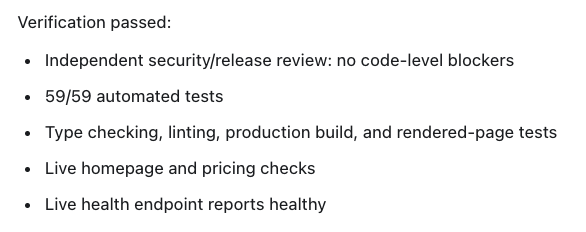
The green light looked convincing
I am using Codex to build LinesFly, my digital waitlist software for walk-in businesses. A new business owner is supposed to create an account, set up the business, add a location, decide how the team will work, create the digital line, and get the QR code customers will scan.
That sequence matters. Each step creates something the next step needs.
Codex had given me all the signals that usually sound like completion: the task was finished, the tests passed, and the work had been verified. If I had stopped there, I would have believed the product was ready.
It was not.
So I became the customer
I used a test email and pretended I knew nothing about the product. I did not test it like the person who had been discussing the code for hours. I tried to use it like someone seeing LinesFly for the first time.
Instead of beginning at step one, the app sent me to step five. The first four setup steps were gone. It appeared to be pulling in an old global account that had been created earlier and was still saved somewhere in the code.
When I reached the dashboard, my account command center was blank. It just kept saying “loading business.” Nothing happened because I had never been allowed to create the business it was trying to load.
I was frustrated, and I knew what the product was supposed to do. A real first-time customer would have had even less reason to stay.
The tests passed. The experience failed.
When I flagged the problem, Codex found the saved account, removed it, and fixed the flow. The AI could solve the problem once I showed it the problem.
But that is the part I do not want to skip over. The problem was still there after the tests passed and after the AI said it had verified its own work.
Automated tests are valuable. I want more of them, not fewer. They can catch things faster than I can and protect working features while the product changes. But a passing test only tells you that the thing the test was written to check behaved the way the test expected.
It does not automatically prove that the entire customer experience makes sense from start to finish.
You still own the workflow
I do not think the need for human testing is ever going away. It should not.
If you are building a business, you need to understand the process, the workflow, and the system from start to finish. That becomes even more important when you want the software to automate work and run quietly in the background.
AI has made it possible for me to build software without knowing how to write the code myself. It has not removed my responsibility for what the software does.
I need to know what a person is supposed to experience. I need to notice when a step is missing. I need to understand what information gets created, where it goes, and what depends on it next. I need to be involved enough to recognize when something that looks technically complete is operationally wrong.
My testing rule now: be test number 60
This is not some huge revelation. Of course you should test what you put out.
The trap is how convincing AI can sound when it tells you everything is done. It can give you a clean summary, a confident verification, and fifty-nine green checks. That confidence can make it tempting to move on.
Do not take the green checks as permission to disappear from the process. Be test number 60.
- Start with a completely new account.Use a fresh test email and avoid any account state left over from development.
- Follow the intended sequence.Do not skip ahead because you already know how the product works.
- Check the result after every step.Make sure the business, location, team settings, line, and QR code actually exist before the next screen needs them.
- Read every message like a customer.A loading screen, empty dashboard, strange redirect, or confusing instruction is part of the product.
- Flag exactly what happened.Tell the AI what you did, what you expected, what happened instead, and where the workflow broke.
- Test the fix from the beginning.Do not resume from step five. Create another clean account and prove the complete journey works.
You may find a bug. You may find an inconsistency. You may simply realize the workflow is technically correct but does not feel right. All three are worth catching before your first customers catch them for you.
A few quick questions
Are automated tests enough for AI-built software?
No. Automated tests can confirm the scenarios they were written to check, but they can still miss a broken customer journey, unexpected saved data, confusing screens, and incorrect steps between screens. A person should test the complete workflow before launch.
How should I test an app built with Codex or another AI coding tool?
Create a brand-new test account and use the product exactly as a first-time customer would. Complete every onboarding step, check the result after each action, test on a real device, and report every skipped step, blank state, confusing message, and incorrect redirect.
Why can all the tests pass while the app is still broken?
A test only proves that its specific assumptions and assertions passed. It may not cover the full sequence a customer follows, old seeded data, account state, integrations, or whether the experience makes sense to a real person.